Beyond the Spreadsheet: Why Material Traceability is becoming the New Standard for Industrial Growth
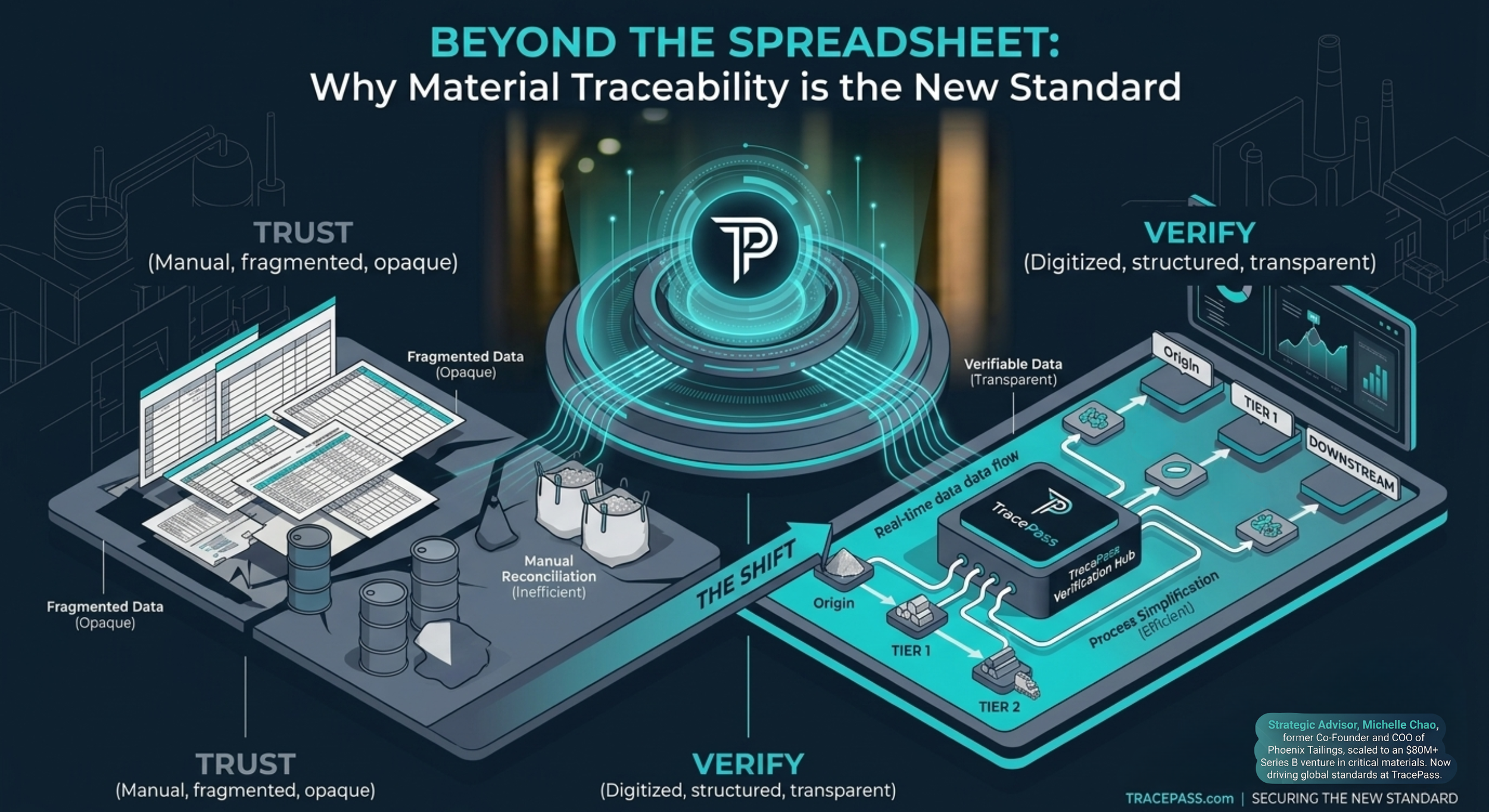
The image emphasizes that material traceability is no longer optional but a new operational standard enabling greater trust, efficiency, and accountability in industrial systems.
An operator’s perspective on the shift from "Trust" to "Verify."
The Problem with Manual Traceability
A 55-gallon steel drum filled with metal, a Super Sack of powder, a large cardboard box lined with a trash bag, filled with mud and dirt.
This is what materials receiving looks like.
Sometimes shipments are clearly labeled. Often they are not. If you are lucky, you receive a spec sheet confirming the quality of the material. More often, you are relying on the supplier’s word for both composition and origin.
In the early days, trust is limited. You build it over time through repeated transactions, testing, and validation. Until then, you run your own analyses, check quality in-house, and apply additional scrutiny before material is approved for use. This often becomes a “trust, but verify” model. But as supply chains become more complex and requirements tighten, “trust” alone is no longer a scalable strategy.
If your downstream customers have strict requirements, you default to the suppliers you trust most. Everyone else is a risk.
The Reality of Operating a Materials Supply Chain
In theory, supply chain best practices are well understood. You vet suppliers. You visit facilities. You run test batches. You validate lots. You qualify a primary supplier, then develop a secondary source to reduce risk. This is textbook operational strategy.
In practice, it is resource-intensive and unevenly applied. Larger companies may have the bandwidth to do this thoroughly. Smaller teams often do not. Operations teams are expected to run lean, and the default approach becomes maintaining the status quo unless a problem forces change or a customer explicitly requires it.
This becomes even more challenging in industries with limited suppliers, fragmented operators, and complex global logistics.
In metals and mining, relationships still matter. Informal agreements are common and data is often fragmented or incomplete. This lack of visibility slows down procurement and qualification cycles, limits your ability to sell to markets with stricter requirements, such as aerospace and automotive and makes it harder to confidently stand behind the origin and quality of materials. For new entrants, it is difficult to reset expectations or enforce higher standards in an established system.
Why This Matters
From an operational standpoint, lack of traceability is not just an inconvenience. It creates real constraints. It slows procurement and qualification cycles, limits who you can sell to, and introduces compliance risk. It also makes it harder to raise capital as investors look more closely at supply chain exposure, particularly as supply chain disruptions and visibility gaps become more prominent risks (Marsh report).
There is also growing pressure from customers to better understand how materials are sourced and processed. Questions around labor practices, environmental impact, and upstream production are becoming more common.
Answering those questions is not straightforward when information is fragmented, inconsistent, or unverifiable. And increasingly, it becomes a blocker.
Why Traceability Is Difficult to Solve
Supply chains were not designed for transparency. They were designed for cost and efficiency.
You are dealing with multiple tiers of suppliers, cross-border logistics, inconsistent documentation, and materials that are physically transformed along the way.
There is no common data standard, no shared system, and incentives are not aligned across participants.
Unlike software, materials move, change form, and are combined with other inputs. Capturing accurate, verifiable data at each step requires coordination across many independent actors.
That is why, despite years of discussion, traceability remains largely manual and fragmented.
Why Now
What has changed is urgency.
Regulatory expectations are increasing. Governments are paying closer attention to supply chains tied to critical materials, particularly as part of broader efforts to de-risk sourcing and reduce dependency on opaque global supply chains. In the U.S., this shows up in defense-related requirements such as DFARS, and incentive structures like the Inflation Reduction Act, where subsidies are increasingly tied to domestic sourcing and supply chain transparency. In Europe, initiatives like the Digital Product Passport are pushing for greater transparency across industrial supply chains.
At the same time, demand is accelerating across industries like energy, automotive, and advanced manufacturing, driven in part by the rapid growth in clean energy technologies and electrification (International Energy Agency analysis).
Customers are asking more questions. Investors are asking more questions. And companies are expected to have better answers.
Transparency is no longer just a reporting exercise. It is increasingly becoming a requirement for doing business.
The Gap and the Opportunity
From my experience, this is not a problem that can be solved with more spreadsheets or one-off audits. It requires infrastructure.
That means systems that standardize how information is captured, reduce manual back-and-forth, and make data usable across companies and borders. It also means integrating into existing workflows in a way that does not add additional burden on already lean operations teams.
A solution only works if it is easy to adopt, requires minimal onboarding, and delivers immediate value through process simplification and better visibility.
This is where platforms like TracePass are starting to build the underlying infrastructure. They are building infrastructure that helps digitize workflows, aggregate fragmented documentation, and guide teams through the collection of required information in a more structured and secure way (see more here).
The goal is not just more data, but better signal. Less noise, clearer visibility, and a more reliable understanding of where materials come from and how they move through the supply chain.
Traceability is moving from a “nice to have” to a core part of modern industrial systems. The question is no longer if it becomes standard, but how quickly companies adapt.
Ready to secure your supply chain? Explore the TracePass Platform.