
The $184 Billion Opacity Tax
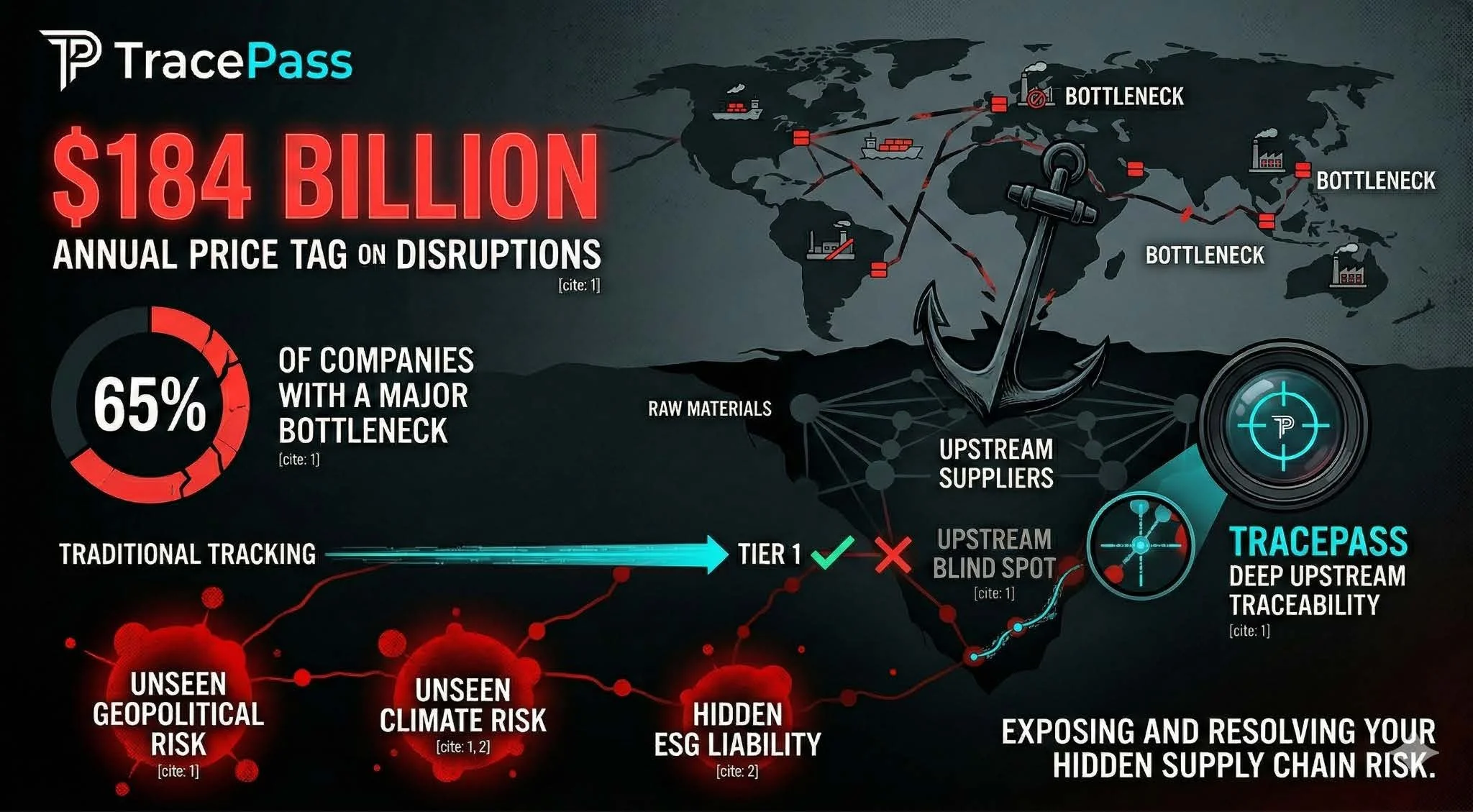
The global supply chain has moved past the point where we can just "set it and forget it." According to recent insights from Marsh, 2026 is becoming a defining year shaped by geopolitical shifts, climate-driven bottlenecks, and a staggering $184 billion annual price tag on disruptions.
For businesses in high-stakes sectors like automotive, defense, and commodities, the message is clear: Visibility isn't a luxury anymore. It’s the baseline for staying in business.
The Disruptors Moving the Needle in 2026
The Marsh report points to several "new normals" that every supply chain leader is currently navigating:
Geopolitical Fragmentation: Constant trade wars and shifting alliances are forcing a total reassessment of sourcing. If you don’t know exactly where your raw materials originate, you are essentially flying blind against sudden tariff hikes and sanctions.
The Climate Bottleneck: With billion-dollar weather disasters now occurring every three weeks, critical waterways like the Panama Canal have become predictable points of failure rather than reliable routes.
The Transparency Mandate: Regulations like the EU’s Carbon Border Adjustment Mechanism (CBAM) are no longer just suggestions. Companies are now legally required to account for the carbon footprint and labor practices of their entire network, including Tier 2 and Tier 3 suppliers.
The TracePass Perspective: Look Deeper Than Tier 1
At TracePass, we don't just see these trends as risks; we see them as a loud wake-up call to modernize. The Marsh report emphasizes that 65% of companies are dealing with at least one major bottleneck, and most of those issues are buried deep within the supply chain where traditional tracking doesn't reach.
Standard risk management usually stops at your direct suppliers. But in 2026, your real exposure and your biggest opportunity for resilience, lives in the upstream.
The Bottom Line: The complexity of 2026 requires us to stop reacting to crises and start anticipating them through traceability. Resilience is more than just having a backup plan; it’s about having the data to act while your competitors are still trying to figure out what went wrong.
Ready to secure your supply chain? Explore the TracePass Platform.
Read FullArticle: Supply chain trends in 2026: A continuation of complexity and risk